

3.1: Lección de práctica guiada 1.1
- Page ID
- 101786

\( \newcommand{\vecs}[1]{\overset { \scriptstyle \rightharpoonup} {\mathbf{#1}} } \)
\( \newcommand{\vecd}[1]{\overset{-\!-\!\rightharpoonup}{\vphantom{a}\smash {#1}}} \)
\( \newcommand{\dsum}{\displaystyle\sum\limits} \)
\( \newcommand{\dint}{\displaystyle\int\limits} \)
\( \newcommand{\dlim}{\displaystyle\lim\limits} \)
\( \newcommand{\id}{\mathrm{id}}\) \( \newcommand{\Span}{\mathrm{span}}\)
( \newcommand{\kernel}{\mathrm{null}\,}\) \( \newcommand{\range}{\mathrm{range}\,}\)
\( \newcommand{\RealPart}{\mathrm{Re}}\) \( \newcommand{\ImaginaryPart}{\mathrm{Im}}\)
\( \newcommand{\Argument}{\mathrm{Arg}}\) \( \newcommand{\norm}[1]{\| #1 \|}\)
\( \newcommand{\inner}[2]{\langle #1, #2 \rangle}\)
\( \newcommand{\Span}{\mathrm{span}}\)
\( \newcommand{\id}{\mathrm{id}}\)
\( \newcommand{\Span}{\mathrm{span}}\)
\( \newcommand{\kernel}{\mathrm{null}\,}\)
\( \newcommand{\range}{\mathrm{range}\,}\)
\( \newcommand{\RealPart}{\mathrm{Re}}\)
\( \newcommand{\ImaginaryPart}{\mathrm{Im}}\)
\( \newcommand{\Argument}{\mathrm{Arg}}\)
\( \newcommand{\norm}[1]{\| #1 \|}\)
\( \newcommand{\inner}[2]{\langle #1, #2 \rangle}\)
\( \newcommand{\Span}{\mathrm{span}}\) \( \newcommand{\AA}{\unicode[.8,0]{x212B}}\)
\( \newcommand{\vectorA}[1]{\vec{#1}} % arrow\)
\( \newcommand{\vectorAt}[1]{\vec{\text{#1}}} % arrow\)
\( \newcommand{\vectorB}[1]{\overset { \scriptstyle \rightharpoonup} {\mathbf{#1}} } \)
\( \newcommand{\vectorC}[1]{\textbf{#1}} \)
\( \newcommand{\vectorD}[1]{\overrightarrow{#1}} \)
\( \newcommand{\vectorDt}[1]{\overrightarrow{\text{#1}}} \)
\( \newcommand{\vectE}[1]{\overset{-\!-\!\rightharpoonup}{\vphantom{a}\smash{\mathbf {#1}}}} \)
\( \newcommand{\vecs}[1]{\overset { \scriptstyle \rightharpoonup} {\mathbf{#1}} } \)
\(\newcommand{\longvect}{\overrightarrow}\)
\( \newcommand{\vecd}[1]{\overset{-\!-\!\rightharpoonup}{\vphantom{a}\smash {#1}}} \)
\(\newcommand{\ket}[1]{\left| #1 \right>}\)
\(\newcommand{\bra}[1]{\left< #1 \right|}\)
\(\newcommand{\braket}[2]{\left< #1 \vphantom{#2} \right| \left. #2 \vphantom{#1} \right>}\)
\(\newcommand{\braopket}[3]{\left< #1 \vphantom{#2}\vphantom{#3} \right| #2 \vphantom{#1}\vphantom{#3} \left| #3 \vphantom{#1}\vphantom{#2} \right>}\)
\(\newcommand{\qmvec}[1]{\mathbf{\vec{#1}}}\)
\(\newcommand{\op}[1]{\hat{\mathbf{#1}}}\)
\(\newcommand{\expect}[1]{\langle #1 \rangle}\)
\(\newcommand{\dfn}[1]{\emph{\textbf{#1}}}\)
Objetivos
Los estudiantes serán capaces de:
- establecer una postura adecuada
- controlar la respiración profunda inhalar
- controlar la respiración profunda exhalación
- establecer una embocadura estándar para tocar latón
- zumbar un tono consistente en la boquilla
- zumbar un tono consistente en el instrumento
Materiales
- Instrumento
- Metrónomo
Actividades
- Enrolle para establecer una postura adecuada.
- Respiración cronometrada Fije el metrónomo en ♩ =72.
- Hacer 4 repeticiones de 4 recuentos adentro, 4 recuentos fuera
- Hacer 4 repeticiones de 2 recuentos adentro, 4 recuentos fuera
- Hacer 4 repeticiones de 1 conteo adentro, 4 recuentos fuera
- Haz 4 repeticiones de 1 conteo adentro, 8 recuentos fuera
- Modelado de Vocales para establecer la cavidad oral abierta
- Hum para establecer embocadura y fijar la boquilla
- 4 encendido, 4 apagado Pon el metrónomo en ♩ =72. Centrarse en la producción de tono consistente de un tono cómodo
- Hacer 4 repeticiones de 4 encendido, 4 apagado
- Descanso por 15 segundos
- Repita los pasos 3, 4.1 y 4.2 tres veces más
- Tonos largos Ensamble el instrumento y ajuste la embocadura adecuada usando el paso 3. Concéntrese en producir un tono consistente en cualquier tono cómodo. Repetir 4 veces
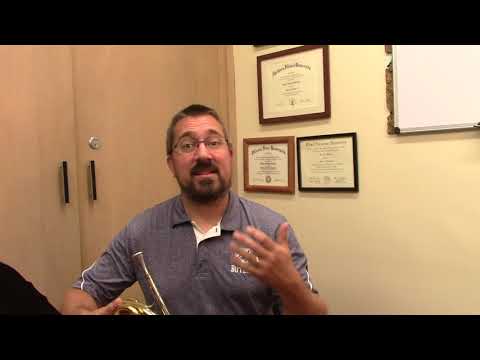
Un elemento de YouTube ha sido excluido de esta versión del texto. Puedes verlo en línea aquí: https://pressbooks.palni.org/brasstechniquesandpedagogy/?p=446