

5.3.1: Ejercicios 5.3
- Page ID
- 116588
\( \newcommand{\vecs}[1]{\overset { \scriptstyle \rightharpoonup} {\mathbf{#1}} } \)
\( \newcommand{\vecd}[1]{\overset{-\!-\!\rightharpoonup}{\vphantom{a}\smash {#1}}} \)
\( \newcommand{\dsum}{\displaystyle\sum\limits} \)
\( \newcommand{\dint}{\displaystyle\int\limits} \)
\( \newcommand{\dlim}{\displaystyle\lim\limits} \)
\( \newcommand{\id}{\mathrm{id}}\) \( \newcommand{\Span}{\mathrm{span}}\)
( \newcommand{\kernel}{\mathrm{null}\,}\) \( \newcommand{\range}{\mathrm{range}\,}\)
\( \newcommand{\RealPart}{\mathrm{Re}}\) \( \newcommand{\ImaginaryPart}{\mathrm{Im}}\)
\( \newcommand{\Argument}{\mathrm{Arg}}\) \( \newcommand{\norm}[1]{\| #1 \|}\)
\( \newcommand{\inner}[2]{\langle #1, #2 \rangle}\)
\( \newcommand{\Span}{\mathrm{span}}\)
\( \newcommand{\id}{\mathrm{id}}\)
\( \newcommand{\Span}{\mathrm{span}}\)
\( \newcommand{\kernel}{\mathrm{null}\,}\)
\( \newcommand{\range}{\mathrm{range}\,}\)
\( \newcommand{\RealPart}{\mathrm{Re}}\)
\( \newcommand{\ImaginaryPart}{\mathrm{Im}}\)
\( \newcommand{\Argument}{\mathrm{Arg}}\)
\( \newcommand{\norm}[1]{\| #1 \|}\)
\( \newcommand{\inner}[2]{\langle #1, #2 \rangle}\)
\( \newcommand{\Span}{\mathrm{span}}\) \( \newcommand{\AA}{\unicode[.8,0]{x212B}}\)
\( \newcommand{\vectorA}[1]{\vec{#1}} % arrow\)
\( \newcommand{\vectorAt}[1]{\vec{\text{#1}}} % arrow\)
\( \newcommand{\vectorB}[1]{\overset { \scriptstyle \rightharpoonup} {\mathbf{#1}} } \)
\( \newcommand{\vectorC}[1]{\textbf{#1}} \)
\( \newcommand{\vectorD}[1]{\overrightarrow{#1}} \)
\( \newcommand{\vectorDt}[1]{\overrightarrow{\text{#1}}} \)
\( \newcommand{\vectE}[1]{\overset{-\!-\!\rightharpoonup}{\vphantom{a}\smash{\mathbf {#1}}}} \)
\( \newcommand{\vecs}[1]{\overset { \scriptstyle \rightharpoonup} {\mathbf{#1}} } \)
\(\newcommand{\longvect}{\overrightarrow}\)
\( \newcommand{\vecd}[1]{\overset{-\!-\!\rightharpoonup}{\vphantom{a}\smash {#1}}} \)
\(\newcommand{\ket}[1]{\left| #1 \right>}\)
\(\newcommand{\bra}[1]{\left< #1 \right|}\)
\(\newcommand{\braket}[2]{\left< #1 \vphantom{#2} \right| \left. #2 \vphantom{#1} \right>}\)
\(\newcommand{\braopket}[3]{\left< #1 \vphantom{#2}\vphantom{#3} \right| #2 \vphantom{#1}\vphantom{#3} \left| #3 \vphantom{#1}\vphantom{#2} \right>}\)
\(\newcommand{\qmvec}[1]{\mathbf{\vec{#1}}}\)
\(\newcommand{\op}[1]{\hat{\mathbf{#1}}}\)
\(\newcommand{\expect}[1]{\langle #1 \rangle}\)
\(\newcommand{\dfn}[1]{\emph{\textbf{#1}}}\)
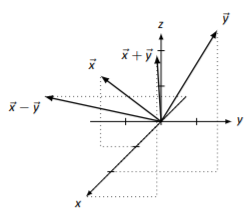
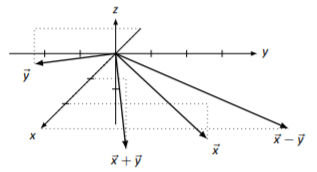
En Ejercicios\(\PageIndex{1}\) —\(\PageIndex{4}\),\(\vec{y}\) se dan vectores\(\vec{x}\) y. Croquis\(\vec{x}\)\(\vec{y}\),,\(\vec{x}+\vec{y}\), y\(\vec{x}-\vec{y}\) en los mismos ejes cartesianos.
\(\vec{x}=\left[\begin{array}{c}{1}\\{-1}\\{2}\end{array}\right],\:\vec{y}=\left[\begin{array}{c}{2}\\{3}\\{2}\end{array}\right]\)
- Contestar
-
\(\vec{x}+\vec{y}=\left[\begin{array}{c}{3}\\{2}\\{4}\end{array}\right],\:\vec{x}-\vec{y}=\left[\begin{array}{c}{-1}\\{-4}\\{0}\end{array}\right]\)
Los bocetos variarán ligeramente dependiendo de la orientación.
\(\vec{x}=\left[\begin{array}{c}{2}\\{4}\\{-1}\end{array}\right],\:\vec{y}=\left[\begin{array}{c}{-1}\\{-3}\\{-1}\end{array}\right]\)
- Contestar
-
\(\vec{x}+\vec{y}=\left[\begin{array}{c}{1}\\{1}\\{-2}\end{array}\right],\:\vec{x}-\vec{y}=\left[\begin{array}{c}{3}\\{7}\\{0}\end{array}\right]\)
Los bocetos variarán ligeramente dependiendo de la orientación.
\(\vec{x}=\left[\begin{array}{c}{1}\\{1}\\{2}\end{array}\right],\:\vec{y}=\left[\begin{array}{c}{3}\\{3}\\{6}\end{array}\right]\)
- Contestar
-
\(\vec{x}+\vec{y}=\left[\begin{array}{c}{4}\\{4}\\{8}\end{array}\right],\:\vec{x}-\vec{y}=\left[\begin{array}{c}{-2}\\{-2}\\{-4}\end{array}\right]\)
Los bocetos variarán ligeramente dependiendo de la orientación.

\(\vec{x}=\left[\begin{array}{c}{0}\\{1}\\{1}\end{array}\right],\:\vec{y}=\left[\begin{array}{c}{0}\\{-1}\\{1}\end{array}\right]\)
- Contestar
-
\(\vec{x}+\vec{y}=\left[\begin{array}{c}{0}\\{0}\\{2}\end{array}\right],\:\vec{x}-\vec{y}=\left[\begin{array}{c}{0}\\{2}\\{0}\end{array}\right]\)
Los bocetos pueden variar ligeramente.

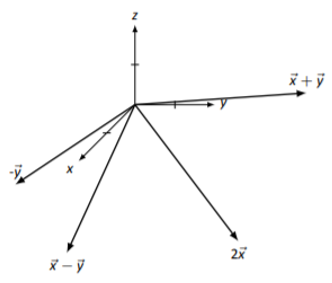
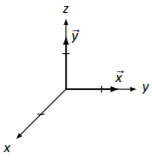
En Ejercicios\(\PageIndex{5}\) -\(\PageIndex{8}\),\(\vec{y}\) se dibujan vectores\(\vec{x}\) y. Croquis\(2\vec{x}\)\(-\vec{y}\),,\(\vec{x}+\vec{y}\), y\(\vec{x}-\vec{y}\) en los mismos ejes cartesianos.

- Contestar
-
Los bocetos pueden variar ligeramente.


- Contestar
-
Los bocetos pueden variar ligeramente.

- Contestar
-
Los bocetos pueden variar ligeramente.

- Contestar
-
Los bocetos pueden variar ligeramente.

En Ejercicios\(\PageIndex{9}\) -\(\PageIndex{12}\), se dan un vector\(\vec{x}\) y un escalar\(a\). Usando Definition 3D Vector Length, calcular las longitudes de\(\vec{x}\) y\(a\vec{x}\), a continuación, compare estas longitudes.
\(\vec{x}=\left[\begin{array}{c}{1}\\{-2}\\{5}\end{array}\right],\: a=2\)
- Contestar
-
\(||\vec{x}||=\sqrt{30}\),\(||a\vec{x}||=\sqrt{120}=2\sqrt{30}\)
\(\vec{x}=\left[\begin{array}{c}{-3}\\{4}\\{3}\end{array}\right],\: a=-1\)
- Contestar
-
\(||\vec{x}||=\sqrt{34}\),\(||a\vec{x}||=\sqrt{34}\)
\(\vec{x}=\left[\begin{array}{c}{7}\\{2}\\{1}\end{array}\right],\: a=5\)
- Contestar
-
\(||\vec{x}||=\sqrt{54}=3\sqrt{6}\),\(||a\vec{x}||=\sqrt{270}=15\sqrt{6}\)
\(\vec{x}=\left[\begin{array}{c}{1}\\{2}\\{-2}\end{array}\right],\: a=3\)
- Contestar
-
\(||\vec{x}||=\sqrt{3}\),\(||a\vec{x}||=\sqrt{27}\)