

1.2: Ecuaciones Diferenciales Ordinarias
- Page ID
- 118056

\( \newcommand{\vecs}[1]{\overset { \scriptstyle \rightharpoonup} {\mathbf{#1}} } \)
\( \newcommand{\vecd}[1]{\overset{-\!-\!\rightharpoonup}{\vphantom{a}\smash {#1}}} \)
\( \newcommand{\dsum}{\displaystyle\sum\limits} \)
\( \newcommand{\dint}{\displaystyle\int\limits} \)
\( \newcommand{\dlim}{\displaystyle\lim\limits} \)
\( \newcommand{\id}{\mathrm{id}}\) \( \newcommand{\Span}{\mathrm{span}}\)
( \newcommand{\kernel}{\mathrm{null}\,}\) \( \newcommand{\range}{\mathrm{range}\,}\)
\( \newcommand{\RealPart}{\mathrm{Re}}\) \( \newcommand{\ImaginaryPart}{\mathrm{Im}}\)
\( \newcommand{\Argument}{\mathrm{Arg}}\) \( \newcommand{\norm}[1]{\| #1 \|}\)
\( \newcommand{\inner}[2]{\langle #1, #2 \rangle}\)
\( \newcommand{\Span}{\mathrm{span}}\)
\( \newcommand{\id}{\mathrm{id}}\)
\( \newcommand{\Span}{\mathrm{span}}\)
\( \newcommand{\kernel}{\mathrm{null}\,}\)
\( \newcommand{\range}{\mathrm{range}\,}\)
\( \newcommand{\RealPart}{\mathrm{Re}}\)
\( \newcommand{\ImaginaryPart}{\mathrm{Im}}\)
\( \newcommand{\Argument}{\mathrm{Arg}}\)
\( \newcommand{\norm}[1]{\| #1 \|}\)
\( \newcommand{\inner}[2]{\langle #1, #2 \rangle}\)
\( \newcommand{\Span}{\mathrm{span}}\) \( \newcommand{\AA}{\unicode[.8,0]{x212B}}\)
\( \newcommand{\vectorA}[1]{\vec{#1}} % arrow\)
\( \newcommand{\vectorAt}[1]{\vec{\text{#1}}} % arrow\)
\( \newcommand{\vectorB}[1]{\overset { \scriptstyle \rightharpoonup} {\mathbf{#1}} } \)
\( \newcommand{\vectorC}[1]{\textbf{#1}} \)
\( \newcommand{\vectorD}[1]{\overrightarrow{#1}} \)
\( \newcommand{\vectorDt}[1]{\overrightarrow{\text{#1}}} \)
\( \newcommand{\vectE}[1]{\overset{-\!-\!\rightharpoonup}{\vphantom{a}\smash{\mathbf {#1}}}} \)
\( \newcommand{\vecs}[1]{\overset { \scriptstyle \rightharpoonup} {\mathbf{#1}} } \)
\(\newcommand{\longvect}{\overrightarrow}\)
\( \newcommand{\vecd}[1]{\overset{-\!-\!\rightharpoonup}{\vphantom{a}\smash {#1}}} \)
\(\newcommand{\ket}[1]{\left| #1 \right>}\)
\(\newcommand{\bra}[1]{\left< #1 \right|}\)
\(\newcommand{\braket}[2]{\left< #1 \vphantom{#2} \right| \left. #2 \vphantom{#1} \right>}\)
\(\newcommand{\braopket}[3]{\left< #1 \vphantom{#2}\vphantom{#3} \right| #2 \vphantom{#1}\vphantom{#3} \left| #3 \vphantom{#1}\vphantom{#2} \right>}\)
\(\newcommand{\qmvec}[1]{\mathbf{\vec{#1}}}\)
\(\newcommand{\op}[1]{\hat{\mathbf{#1}}}\)
\(\newcommand{\expect}[1]{\langle #1 \rangle}\)
\(\newcommand{\dfn}[1]{\emph{\textbf{#1}}}\)
Set
$$E (v) =\ int_a^bf (x, v (x), v' (x))\ dx\]
y para dado\(u_a,\ u_b\in{\mathbb R}\)
$$V=\ {v\ en C^2 [a, b]:\ v (a) =u_a,\ v (b) =u_b\},\]
donde\(y\) y\(f\) sea suficientemente regular. Uno de los problemas básicos en el cálculo de la variación es
(P)\(\min_{v\in V}E(v)\).
Ecuación de Euler
Dejar\(u\in V\) ser una solución de (P), entonces
$$\ frac {d} {dx} f_ {u'} (x, u (x), u' (x)) =f_u (x, u (x), u' (x))\]
pulg\((a,b)\).
Ejercicio\(\PageIndex{1}\): Proof
Para fijo\(\phi\in C^2[a,b]\) con\(\phi(a)=\phi(b)=0\) y real\(\epsilon\),\(|\epsilon|<\epsilon_0\), conjunto\(g(\epsilon)=E(u+\epsilon \phi)\). Ya\(g(0)\le g(\epsilon)\) que sigue\(g'(0)=0\). La integración por partes en la fórmula para\(g'(0)\) y el siguiente lema básico en el cálculo de variaciones implica la ecuación de Euler.
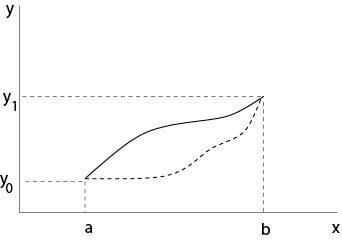
Figura 1.2.1.1: Variaciones admisibles
Lema básico en el cálculo de las variaciones. Let\(h\in C(a,b)\) y
$$\ int_a^bh (x)\ phi (x)\ dx=0$$
para todos\(\phi\in C_0^1(a,b)\). Entonces\(h(x)\equiv0\) adelante\((a,b)\).
Comprobante. Asumir\(h(x_0)>0\) por una\(x_0\in (a,b)\), entonces hay\(\delta>0\) tal que\((x_0-\delta,x_0+\delta)\subset(a,b)\) y\(h(x)\ge h(x_0)/2\) en\((x_0-\delta,x_0+\delta)\).
Set
$$
\ phi (x)
=\ left\ {\ begin {array} {r@ {\ quad\ mbox {if}\ quad} l}
\ left (\ delta^2-|x-x_0|^2\ derecha) ^2 & x\ in (x_0-\ delta, x_0+\ delta)\\
0 & x\ in (a, b)\ setmenos [x_0-\ delta, x_0+\ delta]
\ end {array}\ right.
\]
Así\(\phi\in C_0^1(a,b)\) y
$$\ int_a^b h (x)\ phi (x)\ dx\ ge\ frac {h (x_0)} {2}\ int_ {x_0-\ delta} ^ {x_0+\ delta}\ phi (x)\ dx>0,\]
lo que es una contradicción con el supuesto del lema.
\(\Box\)