

3.3: Lemas del mismo signo
- Page ID
- 114419

\( \newcommand{\vecs}[1]{\overset { \scriptstyle \rightharpoonup} {\mathbf{#1}} } \)
\( \newcommand{\vecd}[1]{\overset{-\!-\!\rightharpoonup}{\vphantom{a}\smash {#1}}} \)
\( \newcommand{\dsum}{\displaystyle\sum\limits} \)
\( \newcommand{\dint}{\displaystyle\int\limits} \)
\( \newcommand{\dlim}{\displaystyle\lim\limits} \)
\( \newcommand{\id}{\mathrm{id}}\) \( \newcommand{\Span}{\mathrm{span}}\)
( \newcommand{\kernel}{\mathrm{null}\,}\) \( \newcommand{\range}{\mathrm{range}\,}\)
\( \newcommand{\RealPart}{\mathrm{Re}}\) \( \newcommand{\ImaginaryPart}{\mathrm{Im}}\)
\( \newcommand{\Argument}{\mathrm{Arg}}\) \( \newcommand{\norm}[1]{\| #1 \|}\)
\( \newcommand{\inner}[2]{\langle #1, #2 \rangle}\)
\( \newcommand{\Span}{\mathrm{span}}\)
\( \newcommand{\id}{\mathrm{id}}\)
\( \newcommand{\Span}{\mathrm{span}}\)
\( \newcommand{\kernel}{\mathrm{null}\,}\)
\( \newcommand{\range}{\mathrm{range}\,}\)
\( \newcommand{\RealPart}{\mathrm{Re}}\)
\( \newcommand{\ImaginaryPart}{\mathrm{Im}}\)
\( \newcommand{\Argument}{\mathrm{Arg}}\)
\( \newcommand{\norm}[1]{\| #1 \|}\)
\( \newcommand{\inner}[2]{\langle #1, #2 \rangle}\)
\( \newcommand{\Span}{\mathrm{span}}\) \( \newcommand{\AA}{\unicode[.8,0]{x212B}}\)
\( \newcommand{\vectorA}[1]{\vec{#1}} % arrow\)
\( \newcommand{\vectorAt}[1]{\vec{\text{#1}}} % arrow\)
\( \newcommand{\vectorB}[1]{\overset { \scriptstyle \rightharpoonup} {\mathbf{#1}} } \)
\( \newcommand{\vectorC}[1]{\textbf{#1}} \)
\( \newcommand{\vectorD}[1]{\overrightarrow{#1}} \)
\( \newcommand{\vectorDt}[1]{\overrightarrow{\text{#1}}} \)
\( \newcommand{\vectE}[1]{\overset{-\!-\!\rightharpoonup}{\vphantom{a}\smash{\mathbf {#1}}}} \)
\( \newcommand{\vecs}[1]{\overset { \scriptstyle \rightharpoonup} {\mathbf{#1}} } \)
\(\newcommand{\longvect}{\overrightarrow}\)
\( \newcommand{\vecd}[1]{\overset{-\!-\!\rightharpoonup}{\vphantom{a}\smash {#1}}} \)
\(\newcommand{\ket}[1]{\left| #1 \right>}\)
\(\newcommand{\bra}[1]{\left< #1 \right|}\)
\(\newcommand{\braket}[2]{\left< #1 \vphantom{#2} \right| \left. #2 \vphantom{#1} \right>}\)
\(\newcommand{\braopket}[3]{\left< #1 \vphantom{#2}\vphantom{#3} \right| #2 \vphantom{#1}\vphantom{#3} \left| #3 \vphantom{#1}\vphantom{#2} \right>}\)
\(\newcommand{\qmvec}[1]{\mathbf{\vec{#1}}}\)
\(\newcommand{\op}[1]{\hat{\mathbf{#1}}}\)
\(\newcommand{\expect}[1]{\langle #1 \rangle}\)
\(\newcommand{\dfn}[1]{\emph{\textbf{#1}}}\)
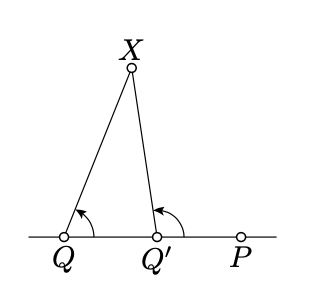
Asumir\(Q' \in [PQ)\) y\(Q' \ne P\). Entonces para cualquiera\(X \in (PQ)\) los ángulos\(PQX\) y\(PQ'X\) tienen el mismo signo.
- Prueba
-
Por la Proposición 2.2.2, para cualquiera\(t \in [0, 1]\) hay un punto único\(Q_t \in [PQ)\) tal que
\[PQ_t = (1 - t) \cdot PQ + t \cdot PQ'.\]
Tenga en cuenta que el mapa\(t \mapsto Q_t\) es continuo,
\(Q_0 = Q\),\(Q_1 = Q'\)
y para cualquiera\(t \in [0, 1]\), tenemos eso\(P \ne Q_t\).
Aplicando Corolario 3.2.1\(P_t = P\), para\(Q_t\),\(X_t = X\), y, obtenemos que\(\angle PQX\) tiene el mismo signo que\(\angle PQ'X\).
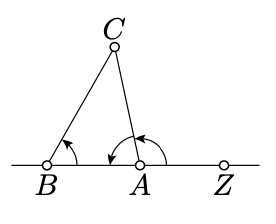
En triángulo arbitrario no degenerado\(ABC\), los ángulos\(ABC, BCA,\) y\(CAB\) tienen el mismo signo.
- Prueba
-
Elige un punto\(Z \in (AB)\) para que\(A\) se encuentre entre\(B\) y\(Z\).
Según Lemma\(\PageIndex{1}\), los ángulos\(ZBC\) y\(ZAC\) tienen el mismo signo.
Tenga en cuenta que\(\measuredangle ABC = \measuredangle ZBC\) y
\[\measuredangle ZAC + \measuredangle CAB \equiv \pi.\]
Por lo tanto,\(\angle CAB\) tiene el mismo signo\(\angle ZAC\) que el que a su vez tiene el mismo signo que\(\measuredangle ABC = \measuredangle ZBC\).
Repetiendo el mismo argumento para\(\angle BCA\) y\(\angle CAB\), obtenemos el resultado.
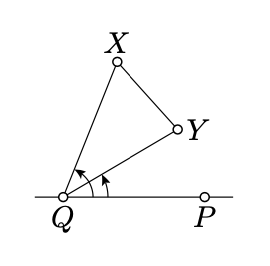
Supongamos que\([XY]\) no se cruza\((PQ)\), entonces los ángulos\(PQX\) y\(PQY\) tienen el mismo signo.
La prueba es casi idéntica a la anterior.
- Prueba
-
De acuerdo con la Proposición 2.2.2, para cualquiera\(t \in [0, 1]\) hay un punto\(X_t \in [XY]\), tal que
\(XX_t = t \cdot XY.\)
Tenga en cuenta que el mapa\(t \mapsto X_t\) es continuo. Por otra parte\(X_0 = X\),\(X_1 = Y\),, y\(X_t \not\in (QP)\) para cualquier\(t \in [0, 1]\).
Aplicando Corolario 3.2.1\(P_t = P\), para\(Q_t = Q\),\(X_t\), y, obtenemos que\(\angle PQX\) tiene el mismo signo que\(\angle PQY\).