

20.6: Área de paralelogramos sólidos
- Page ID
- 114509

\( \newcommand{\vecs}[1]{\overset { \scriptstyle \rightharpoonup} {\mathbf{#1}} } \)
\( \newcommand{\vecd}[1]{\overset{-\!-\!\rightharpoonup}{\vphantom{a}\smash {#1}}} \)
\( \newcommand{\dsum}{\displaystyle\sum\limits} \)
\( \newcommand{\dint}{\displaystyle\int\limits} \)
\( \newcommand{\dlim}{\displaystyle\lim\limits} \)
\( \newcommand{\id}{\mathrm{id}}\) \( \newcommand{\Span}{\mathrm{span}}\)
( \newcommand{\kernel}{\mathrm{null}\,}\) \( \newcommand{\range}{\mathrm{range}\,}\)
\( \newcommand{\RealPart}{\mathrm{Re}}\) \( \newcommand{\ImaginaryPart}{\mathrm{Im}}\)
\( \newcommand{\Argument}{\mathrm{Arg}}\) \( \newcommand{\norm}[1]{\| #1 \|}\)
\( \newcommand{\inner}[2]{\langle #1, #2 \rangle}\)
\( \newcommand{\Span}{\mathrm{span}}\)
\( \newcommand{\id}{\mathrm{id}}\)
\( \newcommand{\Span}{\mathrm{span}}\)
\( \newcommand{\kernel}{\mathrm{null}\,}\)
\( \newcommand{\range}{\mathrm{range}\,}\)
\( \newcommand{\RealPart}{\mathrm{Re}}\)
\( \newcommand{\ImaginaryPart}{\mathrm{Im}}\)
\( \newcommand{\Argument}{\mathrm{Arg}}\)
\( \newcommand{\norm}[1]{\| #1 \|}\)
\( \newcommand{\inner}[2]{\langle #1, #2 \rangle}\)
\( \newcommand{\Span}{\mathrm{span}}\) \( \newcommand{\AA}{\unicode[.8,0]{x212B}}\)
\( \newcommand{\vectorA}[1]{\vec{#1}} % arrow\)
\( \newcommand{\vectorAt}[1]{\vec{\text{#1}}} % arrow\)
\( \newcommand{\vectorB}[1]{\overset { \scriptstyle \rightharpoonup} {\mathbf{#1}} } \)
\( \newcommand{\vectorC}[1]{\textbf{#1}} \)
\( \newcommand{\vectorD}[1]{\overrightarrow{#1}} \)
\( \newcommand{\vectorDt}[1]{\overrightarrow{\text{#1}}} \)
\( \newcommand{\vectE}[1]{\overset{-\!-\!\rightharpoonup}{\vphantom{a}\smash{\mathbf {#1}}}} \)
\( \newcommand{\vecs}[1]{\overset { \scriptstyle \rightharpoonup} {\mathbf{#1}} } \)
\(\newcommand{\longvect}{\overrightarrow}\)
\( \newcommand{\vecd}[1]{\overset{-\!-\!\rightharpoonup}{\vphantom{a}\smash {#1}}} \)
\(\newcommand{\ket}[1]{\left| #1 \right>}\)
\(\newcommand{\bra}[1]{\left< #1 \right|}\)
\(\newcommand{\braket}[2]{\left< #1 \vphantom{#2} \right| \left. #2 \vphantom{#1} \right>}\)
\(\newcommand{\braopket}[3]{\left< #1 \vphantom{#2}\vphantom{#3} \right| #2 \vphantom{#1}\vphantom{#3} \left| #3 \vphantom{#1}\vphantom{#2} \right>}\)
\(\newcommand{\qmvec}[1]{\mathbf{\vec{#1}}}\)
\(\newcommand{\op}[1]{\hat{\mathbf{#1}}}\)
\(\newcommand{\expect}[1]{\langle #1 \rangle}\)
\(\newcommand{\dfn}[1]{\emph{\textbf{#1}}}\)
Dejar\(\square ABCD\) ser un paralelogramo en el plano euclidiano,\(a=AB\) y\(h\) ser la distancia entre las líneas\((AB)\) y\((CD)\). Entonces
\(\text{area }(\blacksquare ABCD)=a\cdot h.\)
- Prueba
-
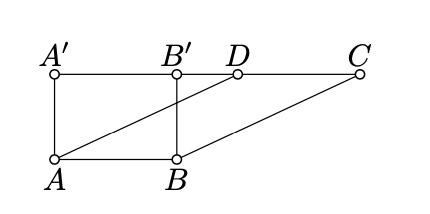
Dejar\(A'\) y\(B'\) denotar los puntos del pie de\(A\) y\(B\) en la línea\((CD)\).
Tenga en cuenta que\(ABB'A'\) es un rectángulo con lados\(a\) y\(h\). Por Teorema 20.5.1,
\[\text{area }(\blacksquare ABB'A')=h\cdot a.\]
Sin pérdida de generalidad, podemos suponer que\(\blacksquare ABCA'\) contiene\(\blacksquare ABCD\) y\(\blacksquare ABB'A'\). En este caso\(\blacksquare ABCA'\) admite dos subdivisiones:
\(\blacksquare ABCA'=\blacksquare ABCD\cup\blacktriangle AA'D=\blacksquare ABB'A'\cup\blacksquare BB'C.\)
\[\begin{aligned} \text{area }( \blacksquare ABCD)&+\text{area }(\blacktriangle AA'D)= \\ &= \text{area }(\blacksquare ABB'A')+ \text{area } (\blacktriangle BB'C). \end{aligned}\]
Tenga en cuenta que
En efecto, dado que los\(ABB'A'\) cuadriláteros y\(ABCD\) son paralelogramos, por Lemma 7.5.1, tenemos eso\(AA'=BB'\),\(AD=BC\), y\(DC=AB=A'B'\). De ello se deduce que\(A'D=B'C\). Aplicando la condición de congruencia SSS, obtenemos 20.6.3.
En particular,
\[\text{area }(\blacktriangle BB'C)=\text{area } (\blacktriangle AA'D). \]
Restar 20.6.4 de 20.4.2, obtenemos que
\[\text{area } (\blacksquare ABCD)=\text{area }(\blacksquare ABB'D).\]
Queda por aplicar 20.6.1.
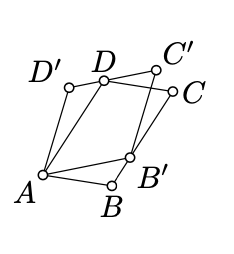
Supongamos\(\square ABCD\) y\(\square AB'C'D'\) son dos paralelogramos tales que\(B'\in[BC]\) y\(D\in [C'D']\). Demostrar que
\(\text{area }(\blacksquare ABCD)=\text{area }(\blacksquare AB'C'D').\)
- Pista
-
Supongamos que\(E\) denota el punto de intersección de las líneas\((BC)\) y\((C'D')\).
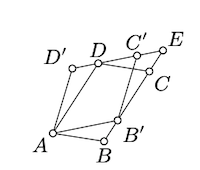
Utilice Proposición\(\PageIndex{1}\) para probar las dos identidades siguientes:
\(\begin{array} {l} {\text{area } (\blacksquare AB'ED) = \text{area } (\blacksquare ABCD),} \\ {\text{area } (\blacksquare AB'ED) = \text{area } (\blacksquare AB'C'D')} \end{array}\)