

1.6.6E: Funciones inversas
- Page ID
- 116467
\( \newcommand{\vecs}[1]{\overset { \scriptstyle \rightharpoonup} {\mathbf{#1}} } \)
\( \newcommand{\vecd}[1]{\overset{-\!-\!\rightharpoonup}{\vphantom{a}\smash {#1}}} \)
\( \newcommand{\dsum}{\displaystyle\sum\limits} \)
\( \newcommand{\dint}{\displaystyle\int\limits} \)
\( \newcommand{\dlim}{\displaystyle\lim\limits} \)
\( \newcommand{\id}{\mathrm{id}}\) \( \newcommand{\Span}{\mathrm{span}}\)
( \newcommand{\kernel}{\mathrm{null}\,}\) \( \newcommand{\range}{\mathrm{range}\,}\)
\( \newcommand{\RealPart}{\mathrm{Re}}\) \( \newcommand{\ImaginaryPart}{\mathrm{Im}}\)
\( \newcommand{\Argument}{\mathrm{Arg}}\) \( \newcommand{\norm}[1]{\| #1 \|}\)
\( \newcommand{\inner}[2]{\langle #1, #2 \rangle}\)
\( \newcommand{\Span}{\mathrm{span}}\)
\( \newcommand{\id}{\mathrm{id}}\)
\( \newcommand{\Span}{\mathrm{span}}\)
\( \newcommand{\kernel}{\mathrm{null}\,}\)
\( \newcommand{\range}{\mathrm{range}\,}\)
\( \newcommand{\RealPart}{\mathrm{Re}}\)
\( \newcommand{\ImaginaryPart}{\mathrm{Im}}\)
\( \newcommand{\Argument}{\mathrm{Arg}}\)
\( \newcommand{\norm}[1]{\| #1 \|}\)
\( \newcommand{\inner}[2]{\langle #1, #2 \rangle}\)
\( \newcommand{\Span}{\mathrm{span}}\) \( \newcommand{\AA}{\unicode[.8,0]{x212B}}\)
\( \newcommand{\vectorA}[1]{\vec{#1}} % arrow\)
\( \newcommand{\vectorAt}[1]{\vec{\text{#1}}} % arrow\)
\( \newcommand{\vectorB}[1]{\overset { \scriptstyle \rightharpoonup} {\mathbf{#1}} } \)
\( \newcommand{\vectorC}[1]{\textbf{#1}} \)
\( \newcommand{\vectorD}[1]{\overrightarrow{#1}} \)
\( \newcommand{\vectorDt}[1]{\overrightarrow{\text{#1}}} \)
\( \newcommand{\vectE}[1]{\overset{-\!-\!\rightharpoonup}{\vphantom{a}\smash{\mathbf {#1}}}} \)
\( \newcommand{\vecs}[1]{\overset { \scriptstyle \rightharpoonup} {\mathbf{#1}} } \)
\(\newcommand{\longvect}{\overrightarrow}\)
\( \newcommand{\vecd}[1]{\overset{-\!-\!\rightharpoonup}{\vphantom{a}\smash {#1}}} \)
\(\newcommand{\ket}[1]{\left| #1 \right>}\)
\(\newcommand{\bra}[1]{\left< #1 \right|}\)
\(\newcommand{\braket}[2]{\left< #1 \vphantom{#2} \right| \left. #2 \vphantom{#1} \right>}\)
\(\newcommand{\braopket}[3]{\left< #1 \vphantom{#2}\vphantom{#3} \right| #2 \vphantom{#1}\vphantom{#3} \left| #3 \vphantom{#1}\vphantom{#2} \right>}\)
\(\newcommand{\qmvec}[1]{\mathbf{\vec{#1}}}\)
\(\newcommand{\op}[1]{\hat{\mathbf{#1}}}\)
\(\newcommand{\expect}[1]{\langle #1 \rangle}\)
\(\newcommand{\dfn}[1]{\emph{\textbf{#1}}}\)
ejercicios de la sección 1.6
Supongamos que la función f es una función uno a uno.
1. Si\(f(6)=7\), encuentra\(f^{-1} (7)\)
2. Si\(f(3)=2\), encuentra\(f^{-1} (2)\)
3. Si\(f^{-1} (-4)=-8\), encuentra\(f(-8)\)
4. Si\(f^{-1} (-2)=-1\), encuentra\(f(-1)\)
5. Si\(f(5)=2\), encuentra\((f(5))^{-1}\)
6. Si\(f(1)=4\), encuentra\((f(1))^{-1}\)
7. Usando la gráfica de que\(f(x)\) se muestra
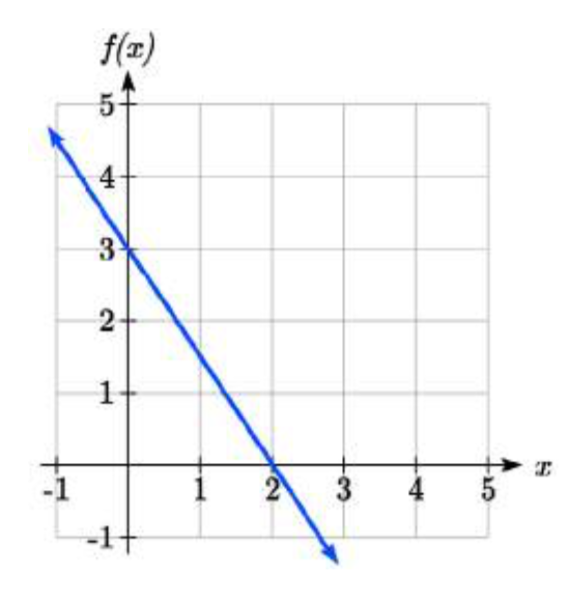
a. Buscar\(f(0)\)
b. Resolver\(f(x)=0\)
c. Encontrar\(f^{-1} (0)\)
d. Resolver\(f^{-1} (x)=0\)
8. Usando la gráfica que se muestra

a. Buscar\(g(1)\)
b. Resolver\(g(x)=1\)
c. Encontrar\(g^{-1} (1)\)
d. Resolver\(g^{-1} (x)=1\)
9. Utilice la tabla a continuación para encontrar las cantidades indicadas.
| \(x\) | 0 | 1 | 2 | 3 | 4 | 5 | 6 | 7 | 8 | 9 |
| \(f(x)\) | 8 | 0 | 7 | 4 | 2 | 6 | 5 | 3 | 9 | 1 |
a. Buscar\(f(1)\)
b. Resolver\(f(x)=3\)
c. Encontrar\(f^{-1}(0)\)
d. Resolver\(f^{-1}(x)=7\)
10. Utilice la siguiente tabla para rellenar los valores faltantes.
| \(t\) | 0 | 1 | 2 | 3 | 4 | 5 | 6 | 7 | 8 |
| \(h(t)\) | 6 | 0 | 1 | 7 | 2 | 3 | 5 | 4 | 9 |
a. Buscar\(h(6)\)
b. Resolver\(h(t)=0\)
c. Encontrar\(h^{-1} (5)\)
d. Resolver\(h^{-1} (t)=1\)
Para cada tabla a continuación, cree una tabla para\(f^{-1} (x).\)
11.
| \(x\) | 3 | 6 | 9 | 13 | 14 |
| \(f(x)\) | 1 | 4 | 7 | 12 | 16 |
Para cada función a continuación, encuentre\(f^{-1} (x)\)
13. \(f(x)=x+3\)
14. \(f(x)=x+5\)
15. \(f(x)= 2 - x\)
16. \(f(x)=3-x\)
17. \(f(x)=11x+7\)
18. \(f(x)=9+10x\)
Para cada función, encuentre un dominio en el que\(f\) sea uno a uno y no decreciente, luego encuentre el inverso de\(f\) restringido a ese dominio.
19. \(f(x)=(x +7)^{2}\)
20. \(f(x)=(x-6)^{2}\)
21. \(f(x)=x^{2} -5\)
22. \(f(x)=x^{2} +1\)
23. Si\(f(x)=x^{3} -5\) y\(g(x)=\sqrt[{3}]{x+5}\), encontrar
a.\(f(g(x))\)
b.\(g(f(x))\)
c. ¿Qué nos dice esto sobre la relación entre\(f(x)\) y\(g(x)\)?
24. Si\(f(x)=\dfrac{x}{2+x}\) y\(g(x)=\dfrac{2x}{1-x}\), encontrar
a.\(f(g(x))\)
b.\(g(f(x))\)
c. ¿Qué nos dice esto sobre la relación entre\(f(x)\) y\(g(x)\)?
- Contestar
-
1. 6
3. -4
5. 1/2
7a. 3
b. 2
c. 2
d. 211.
\(x\) 1 4 7 12 16 \(f^{-1}(x)\) 3 6 9 13 14 13. \(f^{-1}(x) = x -3\)
15. \(f^{-1}(x) = -x + 2\)
17. \(f^{-1}(x) = \dfrac{x - 7}{11}\)
19. Dominio restringido\(x \ge -7\),\(f^{-1}(x) = \sqrt{x} - 7\)
21. Dominio restringido\(x \ge 0\),\(f^{-1}(x) = \sqrt{x + 5}\)
23a. \(f(g(x)) = (\sqrt[3]{x + 5})^3 - 5 = x\)
b.\(g(f(x)) = \sqrt[3]{x^3 - 5 + 5} = x\)
c. Esto quiere decir que son funciones inversas (entre sí)