

27.4: Revisión de funciones trigonométricas
- Page ID
- 117667

\( \newcommand{\vecs}[1]{\overset { \scriptstyle \rightharpoonup} {\mathbf{#1}} } \)
\( \newcommand{\vecd}[1]{\overset{-\!-\!\rightharpoonup}{\vphantom{a}\smash {#1}}} \)
\( \newcommand{\dsum}{\displaystyle\sum\limits} \)
\( \newcommand{\dint}{\displaystyle\int\limits} \)
\( \newcommand{\dlim}{\displaystyle\lim\limits} \)
\( \newcommand{\id}{\mathrm{id}}\) \( \newcommand{\Span}{\mathrm{span}}\)
( \newcommand{\kernel}{\mathrm{null}\,}\) \( \newcommand{\range}{\mathrm{range}\,}\)
\( \newcommand{\RealPart}{\mathrm{Re}}\) \( \newcommand{\ImaginaryPart}{\mathrm{Im}}\)
\( \newcommand{\Argument}{\mathrm{Arg}}\) \( \newcommand{\norm}[1]{\| #1 \|}\)
\( \newcommand{\inner}[2]{\langle #1, #2 \rangle}\)
\( \newcommand{\Span}{\mathrm{span}}\)
\( \newcommand{\id}{\mathrm{id}}\)
\( \newcommand{\Span}{\mathrm{span}}\)
\( \newcommand{\kernel}{\mathrm{null}\,}\)
\( \newcommand{\range}{\mathrm{range}\,}\)
\( \newcommand{\RealPart}{\mathrm{Re}}\)
\( \newcommand{\ImaginaryPart}{\mathrm{Im}}\)
\( \newcommand{\Argument}{\mathrm{Arg}}\)
\( \newcommand{\norm}[1]{\| #1 \|}\)
\( \newcommand{\inner}[2]{\langle #1, #2 \rangle}\)
\( \newcommand{\Span}{\mathrm{span}}\) \( \newcommand{\AA}{\unicode[.8,0]{x212B}}\)
\( \newcommand{\vectorA}[1]{\vec{#1}} % arrow\)
\( \newcommand{\vectorAt}[1]{\vec{\text{#1}}} % arrow\)
\( \newcommand{\vectorB}[1]{\overset { \scriptstyle \rightharpoonup} {\mathbf{#1}} } \)
\( \newcommand{\vectorC}[1]{\textbf{#1}} \)
\( \newcommand{\vectorD}[1]{\overrightarrow{#1}} \)
\( \newcommand{\vectorDt}[1]{\overrightarrow{\text{#1}}} \)
\( \newcommand{\vectE}[1]{\overset{-\!-\!\rightharpoonup}{\vphantom{a}\smash{\mathbf {#1}}}} \)
\( \newcommand{\vecs}[1]{\overset { \scriptstyle \rightharpoonup} {\mathbf{#1}} } \)
\(\newcommand{\longvect}{\overrightarrow}\)
\( \newcommand{\vecd}[1]{\overset{-\!-\!\rightharpoonup}{\vphantom{a}\smash {#1}}} \)
\(\newcommand{\ket}[1]{\left| #1 \right>}\)
\(\newcommand{\bra}[1]{\left< #1 \right|}\)
\(\newcommand{\braket}[2]{\left< #1 \vphantom{#2} \right| \left. #2 \vphantom{#1} \right>}\)
\(\newcommand{\braopket}[3]{\left< #1 \vphantom{#2}\vphantom{#3} \right| #2 \vphantom{#1}\vphantom{#3} \left| #3 \vphantom{#1}\vphantom{#2} \right>}\)
\(\newcommand{\qmvec}[1]{\mathbf{\vec{#1}}}\)
\(\newcommand{\op}[1]{\hat{\mathbf{#1}}}\)
\(\newcommand{\expect}[1]{\langle #1 \rangle}\)
\(\newcommand{\dfn}[1]{\emph{\textbf{#1}}}\)
Rellene todos los valores de las funciones trigonométricas en la siguiente tabla.
\ [\ begin {array} {c||c|c|c|c|c}
& 0 &\ dfrac {\ pi} {6} &\ dfrac {\ pi} {4} &\ dfrac {\ pi} {3} &\ dfrac {\ pi} {2}\
\ hline\ hline\ hline\ sin (x) & & & &
\\ hline\ cos (x) & & & & &\
\ hline\ tan (x) & & amp; & & &
\ end {array}\ nonumber\]
- Contestar
-
\ (\ begin {array} {c||c|c|c|c|c}
x & 0=0^ {\ circ} &\ dfrac {\ pi} {6} =30^ {\ circ} &\ dfrac {\ pi} {4} =45^ {\ circ} &\ dfrac {\ pi} {3} =60^ {\ circ} &\ dfrac {\ pi} {2} =90^ {\ circ}\\ hline
\ hline\ hline\ sin (x) & 0 &\ dfrac {1} {2} &\ dfrac {\ sqrt {2}} {2} &\ dfrac {\ sqrt { 3}} {2} & 1\
\ hline\ cos (x) & 1 &\ dfrac {\ sqrt {3}} {2} &\ dfrac {\ sqrt {2}} {2} &\ dfrac {1} {2} & 0\
\ hline\ tan (x) & 0 &\ dfrac {\ sqrt {3}} {3} & 1 &\ sqrt {3} &\ text {undef.}
\ end {array}\)
Encuentra los valores exactos de
- \(\cos\left(-\dfrac{\pi}{6}\right)\)
- \(\sin\left(-\dfrac{\pi}{4}\right)\)
- \(\tan\left(-\dfrac{\pi}{3}\right)\)
- Contestar
-
- \(\dfrac{\sqrt{3}}{2}\)
- \(\dfrac{-\sqrt{2}}{2}\)
- \(-\sqrt{3}\)
Encuentra el valor exacto de la función trigonométrica.
- \(\sin\left(\dfrac{5\pi}{4}\right)\)
- \(\cos\left(\dfrac{11\pi}{6}\right)\)
[Pista: Usa el especial\(45^\circ-45^\circ-90^\circ\) o\(30^\circ-60^\circ-90^\circ\) triángulos para encontrar la solución.]
- Contestar
-
- \(\dfrac{-\sqrt{2}}{2}\)
- \(\dfrac{\sqrt{3}}{2}\)
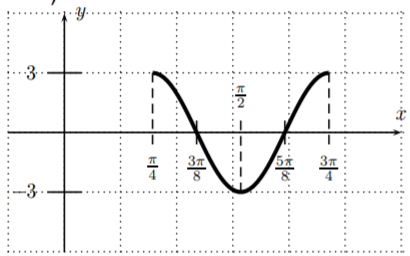
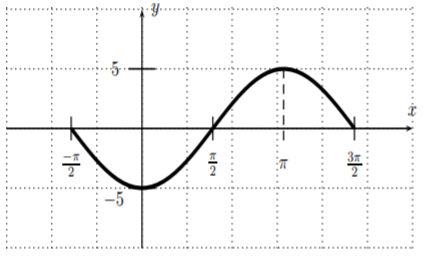
Encuentra la amplitud, el periodo y el desplazamiento de fase de la función dada. Dibuja la gráfica en un intervalo de un periodo. Etiquetar todos los máximos, mínimos e intercepciones.
- \(y=3 \cos\left(4 x-\pi\right)\)
- \(y=-5\sin\left(x+\dfrac{\pi}{2}\right)\)
- Contestar
-
- amplitud\(3\), periodo\(\dfrac{\pi}{2}\), desplazamiento de fase\(\dfrac{\pi}{4}\)
- amplitud\(5\), periodo\(2\pi \), desplazamiento de fase\(\dfrac{-\pi}{2}\)
- amplitud\(3\), periodo\(\dfrac{\pi}{2}\), desplazamiento de fase\(\dfrac{\pi}{4}\)
Encuentra el valor exacto de la función trigonométrica.
- \(\cos\left(\dfrac{\pi}{12}\right)\)[Pista: Utilice las fórmulas de suma y resta de ángulos.]
- \(\cos\left(\dfrac{3\pi}{8}\right)\)[Pista: Usa las fórmulas de medio ángulos.]
- Contestar
-
- \(\dfrac{\sqrt{2}+\sqrt{6}}{4}\)
- \(\dfrac{\sqrt{2-\sqrt{2}}}{2}\)
Dejemos\(\sin(\alpha)=-\dfrac{4}{5}\) y dejemos\(\alpha\) estar en el cuadrante III. Encontrar\(\sin(2\alpha)\),\(\cos(2\alpha)\), y\(\tan(2\alpha)\).
- Contestar
-
\(\sin (2 \alpha)=\dfrac{24}{25}, \cos (2 \alpha)=\dfrac{-7}{25}, \tan (2 \alpha)=\dfrac{-24}{7}\)
Encuentra el valor exacto de:
- \(\sin^{-1}\left(-\dfrac{1}{2}\right)\)
- \(\cos^{-1}\left(-\dfrac{\sqrt{3}}{2}\right)\)
- \(\tan^{-1}\left(-\dfrac{\sqrt{3}}{3}\right)\)
- Contestar
-
- \(\dfrac{-\pi}{6}\)
- \(\dfrac{5 \pi}{6}\)
- \(\dfrac{-\pi}{6}\)
Resolver para\(x\):\(2\sin(x)+\sqrt{3}=0\)
- Contestar
-
\(x=(-1)^{n+1} \dfrac{\pi}{3}+n \pi\), donde\(n=0, \pm 1, \ldots \)
Resolver para\(x\):\(\tan^2(x)-1=0\)
- Contestar
-
\(x=\pm \dfrac{\pi}{4}+n \pi \)donde\(n=0, \pm 1, \ldots \)
Resolver para\(x\).
- \(2\cos^2(x)-1=0\)
- \(2\sin^2(x)+15\sin(x)+7=0\)
- Contestar
-
- \(x=\pm \dfrac{\pi}{4}+2 n \pi\)o\(x=\pm \dfrac{3 \pi}{4}+2 n \pi\) donde\(n=0, \pm 1, \ldots\)
- \((-1)^{n+1} \dfrac{\pi}{6}+n \pi\)donde\(n=0, \pm 1, \ldots\)