

7.12: Comparación de las reacciones SN1 y SN2
- Page ID
- 76237
\( \newcommand{\vecs}[1]{\overset { \scriptstyle \rightharpoonup} {\mathbf{#1}} } \)
\( \newcommand{\vecd}[1]{\overset{-\!-\!\rightharpoonup}{\vphantom{a}\smash {#1}}} \)
\( \newcommand{\dsum}{\displaystyle\sum\limits} \)
\( \newcommand{\dint}{\displaystyle\int\limits} \)
\( \newcommand{\dlim}{\displaystyle\lim\limits} \)
\( \newcommand{\id}{\mathrm{id}}\) \( \newcommand{\Span}{\mathrm{span}}\)
( \newcommand{\kernel}{\mathrm{null}\,}\) \( \newcommand{\range}{\mathrm{range}\,}\)
\( \newcommand{\RealPart}{\mathrm{Re}}\) \( \newcommand{\ImaginaryPart}{\mathrm{Im}}\)
\( \newcommand{\Argument}{\mathrm{Arg}}\) \( \newcommand{\norm}[1]{\| #1 \|}\)
\( \newcommand{\inner}[2]{\langle #1, #2 \rangle}\)
\( \newcommand{\Span}{\mathrm{span}}\)
\( \newcommand{\id}{\mathrm{id}}\)
\( \newcommand{\Span}{\mathrm{span}}\)
\( \newcommand{\kernel}{\mathrm{null}\,}\)
\( \newcommand{\range}{\mathrm{range}\,}\)
\( \newcommand{\RealPart}{\mathrm{Re}}\)
\( \newcommand{\ImaginaryPart}{\mathrm{Im}}\)
\( \newcommand{\Argument}{\mathrm{Arg}}\)
\( \newcommand{\norm}[1]{\| #1 \|}\)
\( \newcommand{\inner}[2]{\langle #1, #2 \rangle}\)
\( \newcommand{\Span}{\mathrm{span}}\) \( \newcommand{\AA}{\unicode[.8,0]{x212B}}\)
\( \newcommand{\vectorA}[1]{\vec{#1}} % arrow\)
\( \newcommand{\vectorAt}[1]{\vec{\text{#1}}} % arrow\)
\( \newcommand{\vectorB}[1]{\overset { \scriptstyle \rightharpoonup} {\mathbf{#1}} } \)
\( \newcommand{\vectorC}[1]{\textbf{#1}} \)
\( \newcommand{\vectorD}[1]{\overrightarrow{#1}} \)
\( \newcommand{\vectorDt}[1]{\overrightarrow{\text{#1}}} \)
\( \newcommand{\vectE}[1]{\overset{-\!-\!\rightharpoonup}{\vphantom{a}\smash{\mathbf {#1}}}} \)
\( \newcommand{\vecs}[1]{\overset { \scriptstyle \rightharpoonup} {\mathbf{#1}} } \)
\(\newcommand{\longvect}{\overrightarrow}\)
\( \newcommand{\vecd}[1]{\overset{-\!-\!\rightharpoonup}{\vphantom{a}\smash {#1}}} \)
\(\newcommand{\avec}{\mathbf a}\) \(\newcommand{\bvec}{\mathbf b}\) \(\newcommand{\cvec}{\mathbf c}\) \(\newcommand{\dvec}{\mathbf d}\) \(\newcommand{\dtil}{\widetilde{\mathbf d}}\) \(\newcommand{\evec}{\mathbf e}\) \(\newcommand{\fvec}{\mathbf f}\) \(\newcommand{\nvec}{\mathbf n}\) \(\newcommand{\pvec}{\mathbf p}\) \(\newcommand{\qvec}{\mathbf q}\) \(\newcommand{\svec}{\mathbf s}\) \(\newcommand{\tvec}{\mathbf t}\) \(\newcommand{\uvec}{\mathbf u}\) \(\newcommand{\vvec}{\mathbf v}\) \(\newcommand{\wvec}{\mathbf w}\) \(\newcommand{\xvec}{\mathbf x}\) \(\newcommand{\yvec}{\mathbf y}\) \(\newcommand{\zvec}{\mathbf z}\) \(\newcommand{\rvec}{\mathbf r}\) \(\newcommand{\mvec}{\mathbf m}\) \(\newcommand{\zerovec}{\mathbf 0}\) \(\newcommand{\onevec}{\mathbf 1}\) \(\newcommand{\real}{\mathbb R}\) \(\newcommand{\twovec}[2]{\left[\begin{array}{r}#1 \\ #2 \end{array}\right]}\) \(\newcommand{\ctwovec}[2]{\left[\begin{array}{c}#1 \\ #2 \end{array}\right]}\) \(\newcommand{\threevec}[3]{\left[\begin{array}{r}#1 \\ #2 \\ #3 \end{array}\right]}\) \(\newcommand{\cthreevec}[3]{\left[\begin{array}{c}#1 \\ #2 \\ #3 \end{array}\right]}\) \(\newcommand{\fourvec}[4]{\left[\begin{array}{r}#1 \\ #2 \\ #3 \\ #4 \end{array}\right]}\) \(\newcommand{\cfourvec}[4]{\left[\begin{array}{c}#1 \\ #2 \\ #3 \\ #4 \end{array}\right]}\) \(\newcommand{\fivevec}[5]{\left[\begin{array}{r}#1 \\ #2 \\ #3 \\ #4 \\ #5 \\ \end{array}\right]}\) \(\newcommand{\cfivevec}[5]{\left[\begin{array}{c}#1 \\ #2 \\ #3 \\ #4 \\ #5 \\ \end{array}\right]}\) \(\newcommand{\mattwo}[4]{\left[\begin{array}{rr}#1 \amp #2 \\ #3 \amp #4 \\ \end{array}\right]}\) \(\newcommand{\laspan}[1]{\text{Span}\{#1\}}\) \(\newcommand{\bcal}{\cal B}\) \(\newcommand{\ccal}{\cal C}\) \(\newcommand{\scal}{\cal S}\) \(\newcommand{\wcal}{\cal W}\) \(\newcommand{\ecal}{\cal E}\) \(\newcommand{\coords}[2]{\left\{#1\right\}_{#2}}\) \(\newcommand{\gray}[1]{\color{gray}{#1}}\) \(\newcommand{\lgray}[1]{\color{lightgray}{#1}}\) \(\newcommand{\rank}{\operatorname{rank}}\) \(\newcommand{\row}{\text{Row}}\) \(\newcommand{\col}{\text{Col}}\) \(\renewcommand{\row}{\text{Row}}\) \(\newcommand{\nul}{\text{Nul}}\) \(\newcommand{\var}{\text{Var}}\) \(\newcommand{\corr}{\text{corr}}\) \(\newcommand{\len}[1]{\left|#1\right|}\) \(\newcommand{\bbar}{\overline{\bvec}}\) \(\newcommand{\bhat}{\widehat{\bvec}}\) \(\newcommand{\bperp}{\bvec^\perp}\) \(\newcommand{\xhat}{\widehat{\xvec}}\) \(\newcommand{\vhat}{\widehat{\vvec}}\) \(\newcommand{\uhat}{\widehat{\uvec}}\) \(\newcommand{\what}{\widehat{\wvec}}\) \(\newcommand{\Sighat}{\widehat{\Sigma}}\) \(\newcommand{\lt}{<}\) \(\newcommand{\gt}{>}\) \(\newcommand{\amp}{&}\) \(\definecolor{fillinmathshade}{gray}{0.9}\)Objetivo de aprendizaje
- distinguir reacciones de sustitución de primer orden o segundo orden
Predicción de mecanismos S N 1 vs S N 2
Al considerar si es probable que se produzca una sustitución nucleofílica a través de un mecanismo S N 1 o S N 2, realmente necesitamos considerar tres factores:
1) El electrófilo: cuando el grupo lábil está unido a un grupo metilo o a un carbono primario, se favorece un mecanismo S N 2 (aquí el electrófilo no está obstaculizado por grupos rodeados, y cualquier carbocatión intermedio sería de alta energía y por lo tanto poco probable). Cuando el grupo lábil está unido a un carbono terciario, alílico o bencílico, un intermedio de carbocatión será relativamente estable y por lo tanto se favorece un mecanismo de S N 1. Estos patrones de reactividad se resumen a continuación.
| Estructura de haluro de alquilo | Posibles reacciones de sustitución |
| metilo y primario | S N 2 solamente |
| secundaria | S N 2 y S N 1 |
| terciario | S N 1 solamente |
| bencílico y alílico primario y secundario | S N 2 y S N 1 |
| terciario bencílico y alílico | S N 1 solamente |
| vinilo y arilo | NO REACCIÓN |
2) El nucleófilo: los nucleófilos potentes, especialmente aquellos con cargas negativas, favorecen el mecanismo S N 2. Los nucleófilos más débiles como el agua o los alcoholes favorecen el mecanismo S N 1.
3) El solvente: Los solventes apróticos polares favorecen el mecanismo S N 2 al potenciar la reactividad del nucleófilo. Los solventes próticos polares favorecen el mecanismo S N 1 estabilizando el estado de transición y el intermedio de carbocatión. Las reacciones de S N 1 se denominan reacciones de solvolisis cuando el disolvente es el nucleófilo.
Estos patrones de reactividad se resumen en la siguiente tabla.
Comparación entre las reacciones S N 2 y S N 1
| Parámetro de reacción | S N 2 | S N 1 |
| estructura de haluro de alquilo | metilo > primario > secundario >>>> terciario | terciario > secodario >>>> primario > metilo |
| nucleófilo | alta concentración de un nucleófilo fuerte | pobre nucleófilo (a menudo el solvente) |
| mecanismo | 1 paso | 2-stp |
| paso de limitación de velocidad | estado de transición bimolecular | formación de carbocationes |
| ley de tarifas | tasa = k [R-X] [Nu] | tasa = k [R-X] |
| estereoquímica | inversión de la configuración | configuración mixta |
| solvente | polar aprótico | prótico polar |
Por ejemplo, la siguiente reacción tiene un bromuro de alquilo terciario como electrófilo, un nucleófilo débil y un disolvente prótico polar (asumiremos que el metanol es el disolvente). Por lo tanto, predecimos con confianza un mecanismo de reacción de S N 1. Debido a que la sustitución ocurre en un carbono quiral, también podemos predecir que la reacción procederá con la racemización.

En la reacción a continuación, por otro lado, el electrófilo es un bromuro de alquilo secundario —con estos, son posibles mecanismos tanto S N 1 como S N 2, dependiendo del nucleófilo y del disolvente. En este ejemplo, el nucleófilo (un anión tiolato) es fuerte y se usa un disolvente prótico polar, por lo que el mecanismo S N 2 se ve fuertemente favorecido. Se espera que la reacción proceda con inversión de configuración.

Ejercicio
1. Determine si es probable que cada reacción de sustitución que se muestra a continuación proceda por un mecanismo S N 1 o S N 2 y explique su razonamiento.
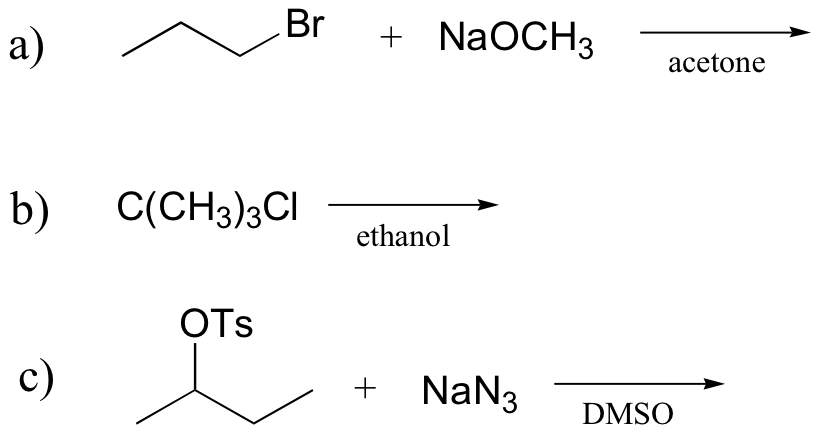
- Contestar
-
a) S N 2 b/c haluro de alquilo primario con un nucleófilo fuerte en un disolvente aprótico polar.
b) S N 1 b/c haluro de alquilo terciario con un nucleófilo débil que también es el disolvente (solvolisis).
c) Los haluros de alquilo secundario S N 2 b/c favorecen este mecanismo cuando reaccionan con un nucleófilo fuerte (y una base débil) en un disolvente aprótico polar.