

31.9: Balanzas
- Page ID
- 94630

\( \newcommand{\vecs}[1]{\overset { \scriptstyle \rightharpoonup} {\mathbf{#1}} } \)
\( \newcommand{\vecd}[1]{\overset{-\!-\!\rightharpoonup}{\vphantom{a}\smash {#1}}} \)
\( \newcommand{\dsum}{\displaystyle\sum\limits} \)
\( \newcommand{\dint}{\displaystyle\int\limits} \)
\( \newcommand{\dlim}{\displaystyle\lim\limits} \)
\( \newcommand{\id}{\mathrm{id}}\) \( \newcommand{\Span}{\mathrm{span}}\)
( \newcommand{\kernel}{\mathrm{null}\,}\) \( \newcommand{\range}{\mathrm{range}\,}\)
\( \newcommand{\RealPart}{\mathrm{Re}}\) \( \newcommand{\ImaginaryPart}{\mathrm{Im}}\)
\( \newcommand{\Argument}{\mathrm{Arg}}\) \( \newcommand{\norm}[1]{\| #1 \|}\)
\( \newcommand{\inner}[2]{\langle #1, #2 \rangle}\)
\( \newcommand{\Span}{\mathrm{span}}\)
\( \newcommand{\id}{\mathrm{id}}\)
\( \newcommand{\Span}{\mathrm{span}}\)
\( \newcommand{\kernel}{\mathrm{null}\,}\)
\( \newcommand{\range}{\mathrm{range}\,}\)
\( \newcommand{\RealPart}{\mathrm{Re}}\)
\( \newcommand{\ImaginaryPart}{\mathrm{Im}}\)
\( \newcommand{\Argument}{\mathrm{Arg}}\)
\( \newcommand{\norm}[1]{\| #1 \|}\)
\( \newcommand{\inner}[2]{\langle #1, #2 \rangle}\)
\( \newcommand{\Span}{\mathrm{span}}\) \( \newcommand{\AA}{\unicode[.8,0]{x212B}}\)
\( \newcommand{\vectorA}[1]{\vec{#1}} % arrow\)
\( \newcommand{\vectorAt}[1]{\vec{\text{#1}}} % arrow\)
\( \newcommand{\vectorB}[1]{\overset { \scriptstyle \rightharpoonup} {\mathbf{#1}} } \)
\( \newcommand{\vectorC}[1]{\textbf{#1}} \)
\( \newcommand{\vectorD}[1]{\overrightarrow{#1}} \)
\( \newcommand{\vectorDt}[1]{\overrightarrow{\text{#1}}} \)
\( \newcommand{\vectE}[1]{\overset{-\!-\!\rightharpoonup}{\vphantom{a}\smash{\mathbf {#1}}}} \)
\( \newcommand{\vecs}[1]{\overset { \scriptstyle \rightharpoonup} {\mathbf{#1}} } \)
\(\newcommand{\longvect}{\overrightarrow}\)
\( \newcommand{\vecd}[1]{\overset{-\!-\!\rightharpoonup}{\vphantom{a}\smash {#1}}} \)
\(\newcommand{\avec}{\mathbf a}\) \(\newcommand{\bvec}{\mathbf b}\) \(\newcommand{\cvec}{\mathbf c}\) \(\newcommand{\dvec}{\mathbf d}\) \(\newcommand{\dtil}{\widetilde{\mathbf d}}\) \(\newcommand{\evec}{\mathbf e}\) \(\newcommand{\fvec}{\mathbf f}\) \(\newcommand{\nvec}{\mathbf n}\) \(\newcommand{\pvec}{\mathbf p}\) \(\newcommand{\qvec}{\mathbf q}\) \(\newcommand{\svec}{\mathbf s}\) \(\newcommand{\tvec}{\mathbf t}\) \(\newcommand{\uvec}{\mathbf u}\) \(\newcommand{\vvec}{\mathbf v}\) \(\newcommand{\wvec}{\mathbf w}\) \(\newcommand{\xvec}{\mathbf x}\) \(\newcommand{\yvec}{\mathbf y}\) \(\newcommand{\zvec}{\mathbf z}\) \(\newcommand{\rvec}{\mathbf r}\) \(\newcommand{\mvec}{\mathbf m}\) \(\newcommand{\zerovec}{\mathbf 0}\) \(\newcommand{\onevec}{\mathbf 1}\) \(\newcommand{\real}{\mathbb R}\) \(\newcommand{\twovec}[2]{\left[\begin{array}{r}#1 \\ #2 \end{array}\right]}\) \(\newcommand{\ctwovec}[2]{\left[\begin{array}{c}#1 \\ #2 \end{array}\right]}\) \(\newcommand{\threevec}[3]{\left[\begin{array}{r}#1 \\ #2 \\ #3 \end{array}\right]}\) \(\newcommand{\cthreevec}[3]{\left[\begin{array}{c}#1 \\ #2 \\ #3 \end{array}\right]}\) \(\newcommand{\fourvec}[4]{\left[\begin{array}{r}#1 \\ #2 \\ #3 \\ #4 \end{array}\right]}\) \(\newcommand{\cfourvec}[4]{\left[\begin{array}{c}#1 \\ #2 \\ #3 \\ #4 \end{array}\right]}\) \(\newcommand{\fivevec}[5]{\left[\begin{array}{r}#1 \\ #2 \\ #3 \\ #4 \\ #5 \\ \end{array}\right]}\) \(\newcommand{\cfivevec}[5]{\left[\begin{array}{c}#1 \\ #2 \\ #3 \\ #4 \\ #5 \\ \end{array}\right]}\) \(\newcommand{\mattwo}[4]{\left[\begin{array}{rr}#1 \amp #2 \\ #3 \amp #4 \\ \end{array}\right]}\) \(\newcommand{\laspan}[1]{\text{Span}\{#1\}}\) \(\newcommand{\bcal}{\cal B}\) \(\newcommand{\ccal}{\cal C}\) \(\newcommand{\scal}{\cal S}\) \(\newcommand{\wcal}{\cal W}\) \(\newcommand{\ecal}{\cal E}\) \(\newcommand{\coords}[2]{\left\{#1\right\}_{#2}}\) \(\newcommand{\gray}[1]{\color{gray}{#1}}\) \(\newcommand{\lgray}[1]{\color{lightgray}{#1}}\) \(\newcommand{\rank}{\operatorname{rank}}\) \(\newcommand{\row}{\text{Row}}\) \(\newcommand{\col}{\text{Col}}\) \(\renewcommand{\row}{\text{Row}}\) \(\newcommand{\nul}{\text{Nul}}\) \(\newcommand{\var}{\text{Var}}\) \(\newcommand{\corr}{\text{corr}}\) \(\newcommand{\len}[1]{\left|#1\right|}\) \(\newcommand{\bbar}{\overline{\bvec}}\) \(\newcommand{\bhat}{\widehat{\bvec}}\) \(\newcommand{\bperp}{\bvec^\perp}\) \(\newcommand{\xhat}{\widehat{\xvec}}\) \(\newcommand{\vhat}{\widehat{\vvec}}\) \(\newcommand{\uhat}{\widehat{\uvec}}\) \(\newcommand{\what}{\widehat{\wvec}}\) \(\newcommand{\Sighat}{\widehat{\Sigma}}\) \(\newcommand{\lt}{<}\) \(\newcommand{\gt}{>}\) \(\newcommand{\amp}{&}\) \(\definecolor{fillinmathshade}{gray}{0.9}\)En esta sección sobre escalas, nuestra principal preocupación será entender cómo las escalas se relacionan con acordes correspondientes para permitir improvisar un solo de jazz. Del mismo modo, entender las relaciones a escala de acordes puede permitir escribir solos de acordes (como un soli de saxo o un coro de gritos en una pieza de conjunto de jazz) donde los tonos que no son acordes provienen de la escala correspondiente.
31.9.1 La Escala de Blues
La escala de blues es idéntica a la escala pentatónica menor (1^ — ♭ 3^ —4^ —5^ — ♭ 7^) excepto con un agregado ♭ 5^/♯ 4^ (1^ — ♭ 3^ —4^ — ♭ 5^ —5^ — ♭ 7^).
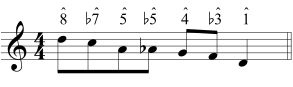
Un conocido ejemplo de la escala blues se da en “Sunshine of Your Love” de Cream.

En la escala de blues, las ♭ 5^ y ♭ 3^ se consideran “notas azules” porque no son tonos de acorde (de una tríada mayor o acorde 7mo dominante). Las notas azules se utilizan comúnmente en el jazz y la música popular. En términos de usar la escala de blues como solista, encontrarás que algunos jugadores usan la escala de blues sobre todos y cada uno de los acordes, y que los oídos de los oyentes a menudo encuentran esto aceptable.
31.9.2 La Escala Bebop
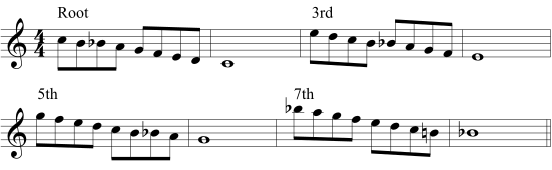
La escala bebop (conocida más específicamente como la escala “bebop dominante” en los textos de la teoría del jazz) es idéntica a la escala mixolídica excepto que tiene un agregado ↑7^. La nota cromática añadida (↑7^) ocurre en pasajes descendentes (de 8^ —7^ — ♭ 7^) como un tono de paso cromático. La escala bebop se usa con mayor frecuencia sobre el acorde 7 dominante. En la forma más rudimentaria de improvisar, se puede usar la escala bebop en octavos descendentes comenzando en el downbeat de un compás, comenzando en la raíz, 3º, 5º o 7º.
31.9.3 Tabla de básculas
Las escalas a continuación están representadas por grados de escala. Las escamas sintéticas como el tono completo, el tono disminuido y el tono completo disminuido tienen muchos respellings enarmónicos aceptables.
| ESCALAS CLÁSICAS | MODOS Y MODOS HÍBRIDOS | JAZZ Y SINTÉTICO |
|---|---|---|
| Mayor (“Jónico”) 1^ —2^ —3^ —4^ —5^ —6^ —7^ |
Mixolidio 1^ —2^ —3^ —4^ —5^ —6^ — ♭ 7^ |
Blues 1^ — ♭ 3^ —4^ — ♭ 5^ —5^ — ♭ 7^ |
| Menor natural (“Eólico”) 1^ —2^ — ♭ 3^ —4^ —5^ — ♭ 6^ — ♭ 7^ |
Lidia 1^ —2^ —3^ — ♯ 4^ —5^ —6^ —7^ |
Bebop Dominante 1^ —2^ —3^ —4^ —5^ —6^ — ♭ 7^ —7^ |
| Armónica menor 1^ —2^ — ♭ 3^ —4^ —5^ — ♭ 6^ —7^ |
Dorian 1^ —2^ — ♭ 3^ —4^ —5^ —6^ — ♭ 7^ |
Bebop Mayor 1^ —2^ —3^ —4^ —5^ — ♯ 5^ —6^ —7^ |
| Melódico Menor 1^ —2^ — ♭ 3^ —4^ —5^ —6^ —7^ |
frigio 1^ — ♭ 2^ — ♭ 3^ —4^ —5^ — ♭ 6^ — ♭ 7^ |
Tono Entero 1^ —2^ —3^ — ♯ 4^ — ♯ 5^ — ♭ 7^ |
| Locrian 1^ — ♭ 2^ — ♭ 3^ —4^ — ♭ 5^ — ♭ 6^ — ♭ 7^ |
Octatónico (medio entero) (escala “disminuida”) 1^ — ♭ 2^ — ♭ 3^ —3^ — ♯ 4^ —5^ —6^ — ♭ 7^ |
|
| Locrian ♯ 2 (6º modo Melódico Menor) 1^ —2^ — ♭ 3^ —4^ — ♭ 5^ — ♭ 6^ — ♭ 7^ |
Octatónico (mitad entera) (escala “disminuida”) 1^ —2^ — ♭ 3^ —4^ — ♯ 4^ — ♯ 5^ —6^ —7^ |
|
| Lidiano-Dominante (4º modo Melódico Menor) 1^ —2^ —3^ — ♯ 4^ —5^ —6^ — ♭ 7^ |
Tono Entero Disminuido (también Escala “Alterada” o Séptimo Modo Melódico Menor) 1^ — ♭ 2^ — ♭ 3^ — ♭ 4^ — ♭ 5^ — ♭ 6^ — ♭ 7^ |
|
| Frígio-Doriano (2do modo Melódico Menor) 1^ — ♭ 2^ — ♭ 3^ —4^ —5^ —6^ — ♭ 7^ |
||
| Lydian-Aumentado (3er modo Melódico Menor) 1^ —2^ —3^ — ♯ 4^ — ♯ 5^ —6^ —7^ |
||
| Mixolydian- ♭ 6^ (5to modo Melódico Menor) 1^ —2^ —3^ —4^ —5^ — ♭ 6^ — ♭ 7^ |