

11.3: Ejercicios
- Page ID
- 117682

\( \newcommand{\vecs}[1]{\overset { \scriptstyle \rightharpoonup} {\mathbf{#1}} } \)
\( \newcommand{\vecd}[1]{\overset{-\!-\!\rightharpoonup}{\vphantom{a}\smash {#1}}} \)
\( \newcommand{\dsum}{\displaystyle\sum\limits} \)
\( \newcommand{\dint}{\displaystyle\int\limits} \)
\( \newcommand{\dlim}{\displaystyle\lim\limits} \)
\( \newcommand{\id}{\mathrm{id}}\) \( \newcommand{\Span}{\mathrm{span}}\)
( \newcommand{\kernel}{\mathrm{null}\,}\) \( \newcommand{\range}{\mathrm{range}\,}\)
\( \newcommand{\RealPart}{\mathrm{Re}}\) \( \newcommand{\ImaginaryPart}{\mathrm{Im}}\)
\( \newcommand{\Argument}{\mathrm{Arg}}\) \( \newcommand{\norm}[1]{\| #1 \|}\)
\( \newcommand{\inner}[2]{\langle #1, #2 \rangle}\)
\( \newcommand{\Span}{\mathrm{span}}\)
\( \newcommand{\id}{\mathrm{id}}\)
\( \newcommand{\Span}{\mathrm{span}}\)
\( \newcommand{\kernel}{\mathrm{null}\,}\)
\( \newcommand{\range}{\mathrm{range}\,}\)
\( \newcommand{\RealPart}{\mathrm{Re}}\)
\( \newcommand{\ImaginaryPart}{\mathrm{Im}}\)
\( \newcommand{\Argument}{\mathrm{Arg}}\)
\( \newcommand{\norm}[1]{\| #1 \|}\)
\( \newcommand{\inner}[2]{\langle #1, #2 \rangle}\)
\( \newcommand{\Span}{\mathrm{span}}\) \( \newcommand{\AA}{\unicode[.8,0]{x212B}}\)
\( \newcommand{\vectorA}[1]{\vec{#1}} % arrow\)
\( \newcommand{\vectorAt}[1]{\vec{\text{#1}}} % arrow\)
\( \newcommand{\vectorB}[1]{\overset { \scriptstyle \rightharpoonup} {\mathbf{#1}} } \)
\( \newcommand{\vectorC}[1]{\textbf{#1}} \)
\( \newcommand{\vectorD}[1]{\overrightarrow{#1}} \)
\( \newcommand{\vectorDt}[1]{\overrightarrow{\text{#1}}} \)
\( \newcommand{\vectE}[1]{\overset{-\!-\!\rightharpoonup}{\vphantom{a}\smash{\mathbf {#1}}}} \)
\( \newcommand{\vecs}[1]{\overset { \scriptstyle \rightharpoonup} {\mathbf{#1}} } \)
\(\newcommand{\longvect}{\overrightarrow}\)
\( \newcommand{\vecd}[1]{\overset{-\!-\!\rightharpoonup}{\vphantom{a}\smash {#1}}} \)
\(\newcommand{\ket}[1]{\left| #1 \right>}\)
\(\newcommand{\bra}[1]{\left< #1 \right|}\)
\(\newcommand{\braket}[2]{\left< #1 \vphantom{#2} \right| \left. #2 \vphantom{#1} \right>}\)
\(\newcommand{\braopket}[3]{\left< #1 \vphantom{#2}\vphantom{#3} \right| #2 \vphantom{#1}\vphantom{#3} \left| #3 \vphantom{#1}\vphantom{#2} \right>}\)
\(\newcommand{\qmvec}[1]{\mathbf{\vec{#1}}}\)
\(\newcommand{\op}[1]{\hat{\mathbf{#1}}}\)
\(\newcommand{\expect}[1]{\langle #1 \rangle}\)
\(\newcommand{\dfn}[1]{\emph{\textbf{#1}}}\)
Encontrar el dominio, las asíntotas verticales y las discontinuidades removibles de las funciones.
- \(f(x)=\dfrac{2}{x-2}\)
- \(f(x)=\dfrac{x^2+2}{x^2-6x+8}\)
- \(f(x)=\dfrac{3x+6}{x^3-4x}\)
- \(f(x)=\dfrac{(x-2)(x+3)(x+4)}{(x-2)^2(x+3)(x-5)}\)
- \(f(x)=\dfrac{x-1}{x^3-1}\)
- \(f(x)=\dfrac{2}{x^3-2x^2-x+2}\)
- Contestar
-
- dominio\(D = \mathbb{R} − \{2\}\), asíntota vertical en\(x = 2\), sin discontinuidades removibles
- \(D = \mathbb{R}−\{2, 4\}\), asíntesis vertical. a\(x = 2\) y\(x = 4\), no descont removible.
- \(D = \mathbb{R}− \{−2, 0, 2\}\), asíntesis vertical. a\(x = 0\) y\(x = 2\), descontíon removible.\(x = −2\)
- \(D = \mathbb{R} − \{−3, 2, 5\}\), asíntesis vertical. a\(x = 2\) y\(x = 5\), descontíon removible.\(x = −3\)
- \(D = \mathbb{R} − \{1\}\), sin asíntesis vertical., descont. removible a\(x = 1\)
- \(D = \mathbb{R} − \{−1, 1, 2\}\), asíntesis vertical. a\(x = −1\) y\(x = 1\) y\(x = 2\), no descont removible.
Encuentra las asíntotas horizontales de las funciones.
- \(f(x)=\dfrac{8x^2+2x+1}{2x^2+3x-2}\)
- \(f(x)=\dfrac{1}{(x-3)^2}\)
- \(f(x)=\dfrac{x^2+3x+2}{x-1}\)
- \(f(x)=\dfrac{12x^3-4x+2}{-3x^3+2x^2+1}\)
- Contestar
-
- \(y = 4\)
- \(y = 0\)
- sin asíntota horizontal (comportamiento asintótico\(y = x + 4\))
- \(y = −4\)
Encuentra las\(x\) - y\(y\) -intercepciones de las funciones.
- \(f(x)=\dfrac{x-3}{x-1}\)
- \(f(x)=\dfrac{x^3-4x}{x^2-8x+15}\)
- \(f(x)=\dfrac{(x-3)(x-1)(x+4)}{(x-2)(x-5)}\)
- \(f(x)=\dfrac{x^2+5x+6}{x^2+2x}\)
- Contestar
-
- \(x\)-interceptar en\(x = 3\),\(y\) -interceptar en\(y = 3\)
- \(x\)-intercepta en\(x = 0\)\(x = −2\) y y\(x = 2\)\(y\) -interceptar en\(y = 0\)
- \(x\)-intercepta en\(x = −4\)\(x = 1\) y y\(x = 3\)\(y\) -interceptar en\(y = \dfrac{6}{5}\)
- \(x\)-intercept at\(x = −3\) (pero no at\(x = −2\) ya que no\(f(−2)\) está definido), no\(y\) -intercept ya que no\(f(0)\) está definido
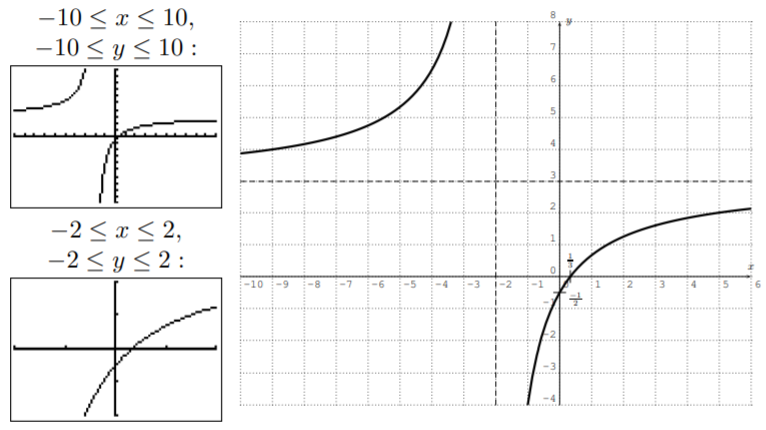
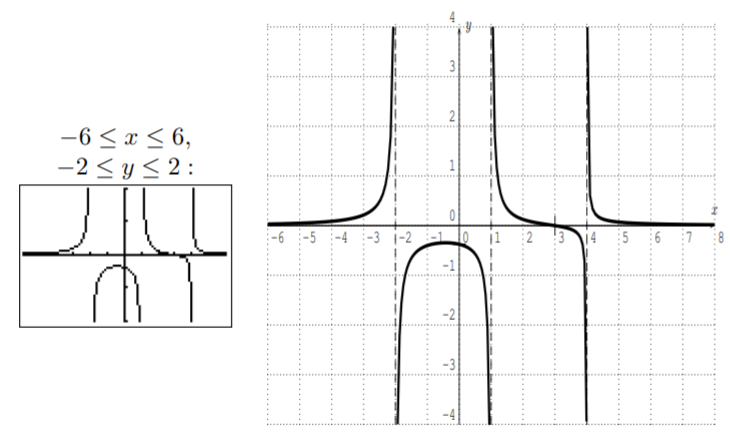
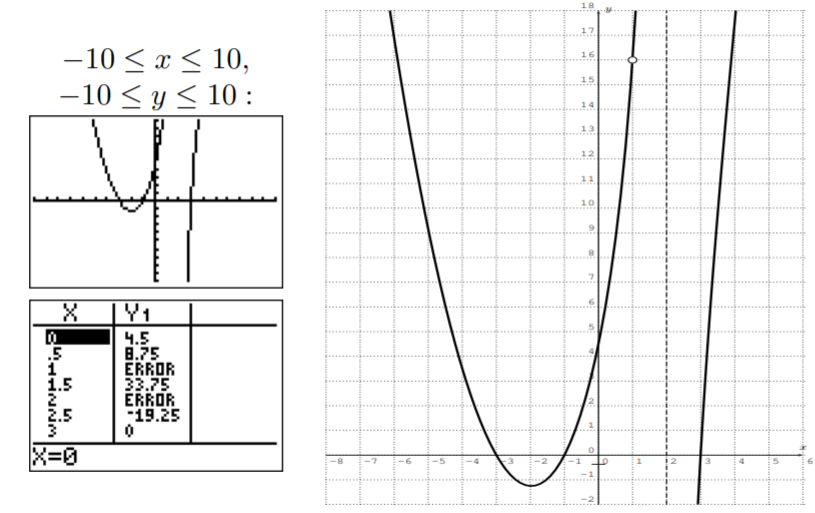
Esbozar la gráfica de la función\(f\) utilizando el dominio de\(f\), las asíntotas horizontales y verticales, las singularidades removibles, las\(x\) - y\(y\) -intercepciones de la función, junto con un boceto de la gráfica obtenida del calculadora.
- \(f(x)=\dfrac{6x-2}{2x+4}\)
- \(f(x)=\dfrac{x-3}{x^3-3x^2-6x+8}\)
- \(f(x)=\dfrac{x^4-10x^2+9}{x^2-3x+2}\)
- \(f(x)=\dfrac{x^3-3x^2-x+3}{x^3-2x^2}\)
- Contestar
-
- \(D = \mathbb{R} − \{2\}\), asíntesis horizontal. \(y = 3\), asíntesis vertical. \(x = −2\), no descont removible.,\(x\) -interceptar en\(x = \dfrac 1 3\),\(y\) -interceptar en\(y = \dfrac{-1}{2}\), graficar:
- \(f(x)=\dfrac{x-3}{(x-4)(x-1)(x+2)}\)tiene dominio\(D = \mathbb{R} − \{−2, 1, 4\}\), asínmpta horizontal. \(y = 0\), asíntesis vertical. \(x = −2\)y\(x = 1\) y\(x = 4\), no descont removible.,\(x\) -interceptar en\(x = 3\),\(y\) -interceptar en\(y = \dfrac{-3}{8} = −0.375\), graficar:
- \(f(x)=\dfrac{(x-3)(x+3)(x-1)(x+1)}{(x-2)(x-1)}\)tiene dominio\(D = \mathbb{R} − \{1, 2\}\), sin asíntesis horizontal, asínptica vertical. \(x = 2\), descont. removible en\(x = 1\),\(x\) -interceptar en\(x = −3\) y\(x = −1\) y\(x = 3\),\(y\) -interceptar en\(y = \dfrac 9 2 = 4.5\), graficar:
- \(f(x)=\dfrac{(x-3)(x-1)(x+1)}{x^{2}(x-2)}\)tiene dominio\(D = \mathbb{R} − \{0, 2\}\), asínmpta horizontal. \(y = 1\), asíntesis vertical. \(x = 0\)y\(x = 2\), sin descont removible.,\(x\) -intercepta en\(x = −1\) y\(x = 1\) y\(x = 3\), no\(y\) -interceptar ya que no\(f(0)\) está definido, graph:
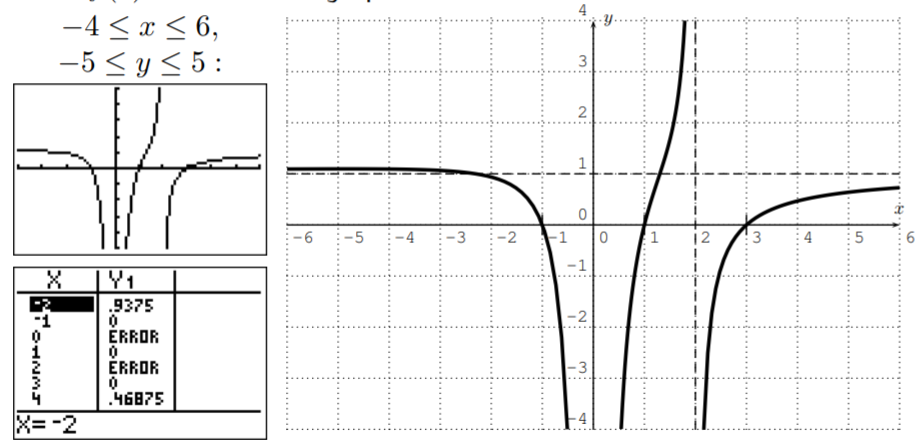
Tenga en cuenta que la gráfica cruza la asíntota horizontal aproximadamente\(x \approx-2.3\) y se acerca\(y = 1\) a la asíntota desde arriba
Encuentra una función racional\(f\) que satisfaga todas las propiedades dadas.
- asíntota vertical en\(x=4\) y asíntota horizontal\(y=0\)
- asíntotas verticales en\(x=2\)\(x=3\) y asíntota horizontal\(y=5\)
- singularidad removible en\(x=1\) y sin asíntota horizontal
- Contestar
-
- por ejemplo\(f(x)=\dfrac{1}{x-4}\)
- por ejemplo\(f(x)=\dfrac{5 x^{2}}{x^{2}-5 x+6}\)
- por ejemplo\(f(x)=\dfrac{x^{2}-x}{x-1}\)